
Choosing the right product filter plugin can have a direct impact on how well a WooCommerce store converts, especially once the catalog starts growing. As product counts increase, shoppers need a faster and more intuitive way to narrow results by category, price, attributes, stock status, brand, and other buying criteria. Without that, product discovery becomes slower, more frustrating, and more likely to end in abandonment.
That makes FiboFilters vs Dynamic AJAX Product Filters for WooCommerce a useful comparison for store owners, developers, and agencies. Both plugins are designed to improve filtering, but they are built around different priorities. FiboFilters leans more toward polished front-end usability, mobile friendliness, and a streamlined filtering experience. Dynamic AJAX Product Filters for WooCommerce is more focused on deeper filtering control, broader filter coverage, flexible placement, advanced AJAX behavior, and stronger SEO-friendly URL handling.
This comparison looks at both plugins objectively, with a focus on practical store needs rather than feature lists alone. If you want a cleaner shopper experience with simpler setup, one plugin may feel like the better fit. If you need a highly configurable, reload-free AJAX filtering system that can adapt to more complex catalogs and SEO requirements, the other will stand out more clearly.
FiboFilters vs Dynamic AJAX Product Filters for WooCommerce: Quick Answer
FiboFilters is better for WooCommerce stores that want a polished, mobile-friendly, and easy-to-manage filtering experience with strong front-end usability.
Dynamic AJAX Product Filters for WooCommerce is better for stores that need more filtering options, deeper control over filter behavior, SEO-friendly URL structures, and a fully reload-free AJAX experience across more complex catalog setups. It supports filtering by categories, tags, attributes, price, rating, brand, stock, sale status, SKU, dimensions, discount, date, search, custom fields, and custom taxonomies, while also supporting AJAX pagination, AJAX sorting, multiple URL modes, shortcodes, widgets, blocks, and builder integrations.

It also works across shop pages, category archives, tag archives, attribute archives, brand archives, custom taxonomy archives, and many builder-based product grids, which makes it a better fit for stores with more customized WooCommerce setups.
For stores with simple filtering needs and a strong focus on front-end polish, FiboFilters is a credible option. For stores that expect their filtering needs to grow over time, Dynamic AJAX Product Filters for WooCommerce offers more depth, flexibility, and long-term value.
What Each Plugin Is Built to Do
Understanding what each plugin is designed to prioritize makes the rest of the comparison easier to follow. While both tools improve WooCommerce filtering, they are not trying to win in exactly the same way.
Fibo Filters: Built for Smoother Shopping and Faster Adoption
FiboFilters is designed for stores that want filtering to feel clean, fast, and easy for shoppers to use. Its strongest positioning is around front-end experience, especially for stores that care about mobile usability, polished filter interactions, and a more streamlined setup. In practical terms, that makes it appealing for merchants who want to improve catalog browsing without spending too much time configuring complex filter logic.
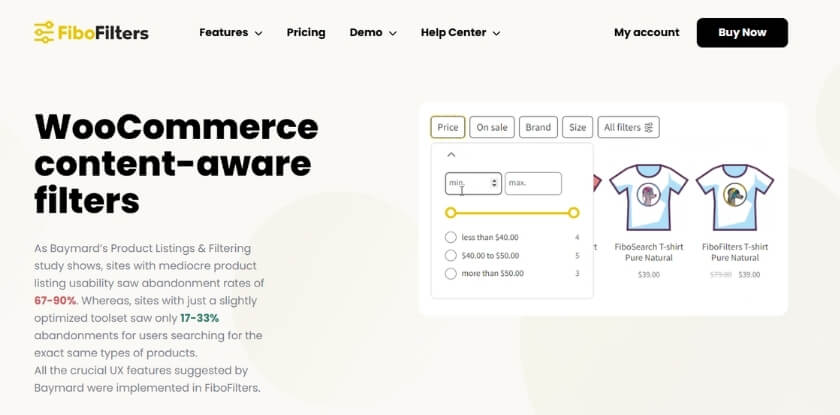
FiboFilters is especially relevant for stores where visual browsing matters a lot, such as fashion, furniture, home decor, and lifestyle catalogs. In those environments, a smooth filter experience can improve product discovery and reduce friction on both desktop and mobile. The tradeoff is that it is generally less centered on advanced admin-side control and SEO-heavy filter strategies.
FiboFilters is mainly built for:
- Stores that want a polished shopper-facing experience
- Merchants who prefer easier onboarding
- Mobile-first storefronts
- Catalogs where visual UX matters more than deep filter logic
- Teams that want filtering to work well out of the box
Dynamic AJAX Product Filters: Built for Flexibility, Control, and Scale
Dynamic AJAX Product Filters for WooCommerce is built for stores that need broader filtering coverage and more control over how filters behave across different shop contexts. It is designed to work not only on standard shop and category pages, but also across tag archives, attribute archives, brand archives, custom taxonomy archives, and many builder or custom product-grid setups. That wider compatibility reflects what many store owners look for in AJAX product filters for WooCommerce, especially when flexibility matters across different catalog structures.
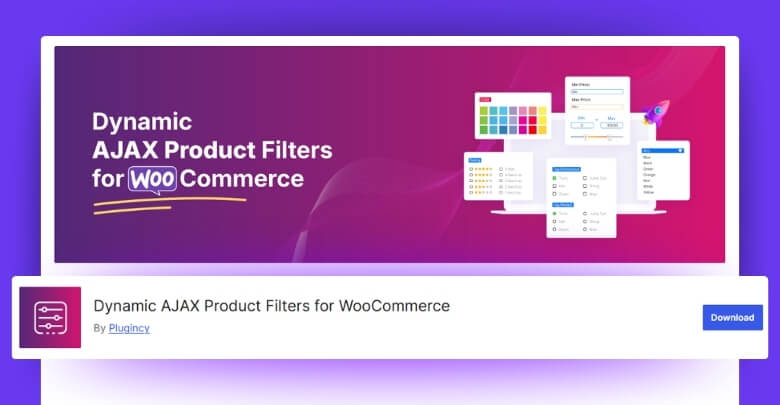
Its feature set also shows that it is aimed at more complex WooCommerce use cases. It supports AJAX filtering, AJAX pagination, and AJAX sorting without forcing full page reloads. It also supports multiple URL modes, including AJAX-only behavior, query-string URLs, and SEO-friendly pretty permalinks. On top of that, it covers a broader mix of filter sources, including categories, attributes, tags, price, rating, brand, stock, sale status, SKU, dimensions, discount, date, search, custom fields, and custom taxonomies.
That makes it a stronger fit for stores that expect filtering needs to grow with the catalog, especially when different product types, custom data structures, SEO landing-page opportunities, or advanced filter layouts become important.
Dynamic AJAX Product Filters is mainly built for:
- Stores with expanding or more complex catalogs
- Agencies and developers who need more control
- Businesses using custom fields or custom taxonomies
- SEO-conscious WooCommerce stores
- Merchants who want fully reload-free AJAX filtering
- Stores that may need different filters on different pages
The core difference in positioning
The simplest way to frame the difference is this:
- FiboFilters is built to make filtering feel cleaner and easier.
- Dynamic AJAX Product Filters for WooCommerce is built to make filtering more configurable and scalable.
That does not automatically make one better than the other for every store. A smaller store with straightforward filtering needs may prefer the simplicity and front-end polish of FiboFilters. A larger or growing store will often benefit more from a filter system that supports more data sources, more placement options, more logic control, and more SEO flexibility.
Core feature comparison table
The fastest way to compare these plugins is to look at what they actually support in day-to-day WooCommerce use. Both plugins cover the basics of product filtering, but Dynamic AJAX Product Filters for WooCommerce goes deeper in filter sources, placement options, AJAX behavior, and SEO-oriented controls, while FiboFilters stays more focused on streamlined usability and front-end experience.
| Feature Area | FiboFilters | Dynamic AJAX Product Filters for WooCommerce |
| AJAX filtering | Yes | Yes |
| Full reload-free filtering | Yes | Yes |
| AJAX pagination | Not a primary focus | Yes |
| AJAX sorting | Not a primary focus | Yes |
| Category filters | Yes | Yes |
| Attribute filters | Yes | Yes |
| Tag filters | Available, but less central to its positioning | Yes |
| Price filters | Yes | Yes |
| Rating filters | Available, but less central to its positioning | Yes |
| Stock status filters | Available, but less central to its positioning | Yes |
| Brand filters | Supported through integrations | Yes |
| Sale status filters | Available, but less central to its positioning | Yes |
| SKU filtering | Available, but less central to its positioning | Yes |
| Discount filtering | Available, but less central to its positioning | Yes |
| Date filtering | Available, but less central to its positioning | Yes |
| Dimension filtering | Available, but less central to its positioning | Yes |
| Custom field filtering | Yes, including ACF-based setups | Yes |
| Custom taxonomy filtering | Yes | Yes |
| Multi-select filters | Yes | Yes |
| AND/OR logic | Not a primary focus | Yes |
| Apply/reset controls | Yes | Yes |
| Active filter chips or selected-filter display | Yes | Yes |
| Widgets, shortcodes, blocks | Flexible placement supported | Yes |
| Elementor support | Not a primary focus | Yes |
| Gutenberg support | Not a primary focus | Yes |
| Multiple URL modes | More limited | Yes |
| SEO-friendly permalinks | Limited | Yes |
| Indexable filtered pages | Limited | Yes |
| Mobile filtering UX | Strong | Strong |
| Different filters for different pages | Less emphasized | Yes |
What this table shows at a glance
The comparison becomes clearer when you look beyond the basic “yes or no” feature checklist.
FiboFilters is the simpler option for stores that want smoother front-end filtering with less setup friction. Dynamic AJAX Product Filters for WooCommerce is the broader option for stores that need deeper filtering control, flexible placement, and stronger SEO-related filter handling.
Filtering depth and supported filter types
Both plugins handle standard WooCommerce filtering, but they differ in how far they can go once the catalog becomes more detailed.
FiboFilters is better suited to stores with simpler filtering needs and a stronger focus on shopper experience. It works well when customers mainly need to filter by common product data such as categories, price, and attributes.
Dynamic AJAX Product Filters for WooCommerce is the stronger choice when filtering needs become more layered, especially for stores that rely on extra product data, more precise narrowing, or advanced combinations.
| Filtering Need | Better Fit |
| Standard category, attribute, and price filtering | FiboFilters |
| Visual, shopper-friendly filtering for straightforward catalogs | FiboFilters |
| Stock status, SKU, sale, or rating-based filtering | Dynamic AJAX Product Filters |
| Custom fields and custom taxonomies | Dynamic AJAX Product Filters |
| More advanced filter logic and broader filter combinations | Dynamic AJAX Product Filters |
| Stores expecting filtering needs to grow over time | Dynamic AJAX Product Filters |
Dynamic AJAX Product Filters supports a broader set of filter sources, including tags, ratings, stock status, sale status, SKU, discount percentage, date, dimensions, custom fields, and custom taxonomies, along with advanced filter logic such as multi-select behavior and applicable AND / OR conditions. That gives it more depth for stores with larger inventories or more technical product data.
User experience, AJAX behavior, and mobile usability
For many WooCommerce stores, filtering is not just about what shoppers can filter by. It is also about how smooth the process feels while they browse. A plugin may support many filter types, but if the experience feels clunky, slow, or awkward on mobile, it can still hurt product discovery and conversions.
FiboFilters puts more emphasis on front-end polish
FiboFilters is positioned as the more UX-first option in this comparison. It is designed to make filtering feel fast, fluid, and easy to use, with particular emphasis on mobile browsing and a cleaner shopper-facing experience. That makes it a strong fit for stores where presentation and ease of use matter just as much as raw filtering capability.
For storefronts in categories like fashion, furniture, beauty, or home decor, that polished experience can be a meaningful advantage. These stores often depend on visual browsing, and smoother filtering can reduce friction as shoppers narrow down products on smaller screens.
Dynamic AJAX Product Filters focuses on a fully dynamic filtering flow
Dynamic AJAX Product Filters for WooCommerce also delivers a strong user experience, but its key strength is not just polish. It is the completeness of the AJAX filtering flow that makes it a more capable option for stores that want WooCommerce product filters to feel fast, smooth, and consistent across the full browsing journey. The plugin supports AJAX filtering, AJAX pagination, and AJAX sorting, so shoppers can refine results, move between pages, and change sort order without full page reloads. It also includes active-filter chips, apply and reset controls, a customizable loader, overlay while filtering, smart auto-scroll, and a wait cursor during filtering.
That gives stores a more consistently dynamic browsing experience across the full product discovery journey, not only during the first filter click. For stores with larger catalogs or more layered browsing paths, this can improve both usability and perceived speed.
Mobile usability comparison
Both plugins support mobile-friendly filtering, but they do so with different strengths.
FiboFilters is described as more mobile-first in its overall positioning, which suggests a stronger emphasis on shopper experience on smaller screens. Dynamic AJAX Product Filters is fully responsive and includes four mobile filter styles, mobile-specific UI modes such as floating or off-canvas experiences, configurable breakpoints, and the option to move sidebar filters above products on mobile.
So while FiboFilters may feel more naturally polished from a mobile UX standpoint, Dynamic AJAX Product Filters offers more control over how mobile filtering is displayed and behaves.
| UX Priority | Better Fit |
| Polished shopper-facing filter experience | FiboFilters |
| Mobile-first browsing feel | FiboFilters |
| Fully dynamic filtering, sorting, and pagination | Dynamic AJAX Product Filters |
| More control over mobile filter layouts | Dynamic AJAX Product Filters |
| Stronger AJAX interaction depth | Dynamic AJAX Product Filters |
FiboFilters is the better fit for stores prioritizing polish and mobile usability, while Dynamic AJAX Product Filters for WooCommerce is the better fit for stores that want a more complete AJAX filtering flow.
SEO, URL control, and indexable filter pages
Filtering can improve product discovery, but it can also create SEO problems if filtered URLs are not managed carefully. On larger WooCommerce stores, uncontrolled filter combinations can lead to duplicate or near-duplicate pages, thin indexed results, and wasted crawl activity. That is why this part of the comparison matters more than it may seem at first glance.
FiboFilters keeps SEO more limited and simpler
FiboFilters takes a more conservative approach to filter SEO. It supports standard filtered states and basic sharing of filtered results, but its indexable page capabilities appear more limited, and dedicated filter-page functionality looks less mature. In practical terms, that makes FiboFilters easier to live with for stores that do not want to turn filtered results into search-targeted landing pages.
For many stores, that is perfectly acceptable. If filtered pages are mainly there to help users browse, and not to rank in search, a simpler SEO setup can reduce the risk of accidental index bloat.
Dynamic AJAX Product Filters offers more SEO control
Dynamic AJAX Product Filters for WooCommerce is built with much more direct control over filter URLs and metadata. It supports multiple URL modes, including AJAX-only behavior, query-string URLs, and SEO-friendly pretty permalinks. It also allows customizable permalink structures, custom URL prefixes for filter types, and dynamic SEO meta output based on active filter values. The plugin supports custom templates for page titles, meta descriptions, and meta keywords, along with Open Graph and Twitter meta output.
This gives store owners more freedom to decide how filtered states should behave. A store can keep some filter interactions purely AJAX-driven, use crawlable URLs where useful, or create cleaner permalink structures for selected filter combinations. That flexibility is especially valuable for SEO-focused stores that want filtered category states to support search demand without making every filter combination indexable.
What this means in practice
The difference is not just technical. It changes how each plugin fits different growth strategies.
- A store that wants low-maintenance filtering for shoppers may be comfortable with FiboFilters’ simpler SEO posture.
- A store that wants tighter crawl control, cleaner filtered URLs, and the option to build indexable filter-driven landing pages will usually get more value from Dynamic AJAX Product Filters.
| SEO Need | Better Fit |
| Simpler filtered-page behavior | FiboFilters |
| SEO-friendly filter permalinks | Dynamic AJAX Product Filters |
| More control over filtered URL structure | Dynamic AJAX Product Filters |
| Dynamic meta output based on active filters | Dynamic AJAX Product Filters |
| Filter landing-page potential | Dynamic AJAX Product Filters |
| Lower-complexity SEO setup | FiboFilters |
FiboFilters is better for stores that want simpler filtered-page behavior with less SEO configuration. Dynamic AJAX Product Filters for WooCommerce is better for stores that need cleaner filter URLs, stronger indexation control, and more flexibility for SEO-focused filtered landing pages.
Setup Experience, Flexibility, And Compatibility
A filter plugin can look strong on paper and still create extra work if setup is awkward or if it struggles with the way a WooCommerce store is actually built. That is why implementation matters almost as much as features.
FiboFilters is easier for merchants who want a faster setup path
FiboFilters is the more straightforward option for teams that want to get filters running with less decision-making. Its overall positioning favors smoother onboarding and a less technical admin experience, which can make it easier for non-technical store owners to launch filtering without spending much time on configuration strategy.
That makes it a good match for standard WooCommerce stores using common catalog structures and conventional theme setups.
Dynamic AJAX Product Filters gives more control over implementation
Dynamic AJAX Product Filters for WooCommerce requires a bit more setup thought, but that extra effort comes from a wider implementation range. The plugin supports classic widgets, Gutenberg blocks, Elementor widgets, and shortcodes, including separate shortcodes for the main filter area, single filters, and selected filters. It also supports filter visibility control, different filters for different pages, built-in templates, collapsible sections, and multiple layout options including popup, drawer, and top-bar style views.
That makes it easier to tailor filter placement to different shop contexts instead of using one fixed filter design everywhere.
Compatibility matters more on custom builds
This is another area where the two plugins serve slightly different users. FiboFilters appears reliable across common WooCommerce themes, but Dynamic AJAX Product Filters is the stronger option for stores using page builders, custom product grids, or more customized store architecture. It is designed to work across shop pages, category archives, tag archives, attribute archives, brand archives, custom taxonomy archives, and many builder-driven product loops. It also supports integrations with Elementor, Gutenberg, WPBakery, Divi, Beaver Builder, Oxygen, Bricks, JetEngine Listing Grid, Woo Product Grid, and WC Product Table.
That broader implementation support is particularly useful for agencies and developers building WooCommerce stores that do not rely on a default theme structure.
| Implementation Need | Better Fit |
| Faster onboarding for non-technical users | FiboFilters |
| Simpler day-to-day setup | FiboFilters |
| More control over filter placement | Dynamic AJAX Product Filters |
| Different filters on different pages | Dynamic AJAX Product Filters |
| Better fit for builder-heavy or custom setups | Dynamic AJAX Product Filters |
| Greater flexibility as the store evolves | Dynamic AJAX Product Filters |
FiboFilters is better for stores that want a simpler setup and easier day-to-day management. Dynamic AJAX Product Filters for WooCommerce is better for stores that need more control over placement, page-specific filtering, and compatibility with builder-based or more customized WooCommerce setups.
Support and documentation
Support quality matters more once a store moves beyond a simple filter setup. Even a strong plugin can become frustrating if documentation is thin, troubleshooting is unclear, or implementation guidance is hard to follow.
FiboFilters offers a more structured documentation experience, which may help merchants who value clearer onboarding and easier navigation through setup resources. That can be useful for store owners who want a more guided learning path when configuring filters or adjusting the shopper experience.
Dynamic AJAX Product Filters for WooCommerce also provides documentation across setup, SEO, styling, and plugin settings, and it is a stronger fit for users who need guidance tied to broader implementation flexibility. For stores working with custom layouts, advanced filter behavior, or SEO-focused setups, that kind of documentation depth can be more valuable than a simpler help structure.
| Support need | Better fit |
| More structured documentation flow | FiboFilters |
| Easier learning path for standard setups | FiboFilters |
| Documentation tied to broader filtering control | Dynamic AJAX Product Filters |
| Better fit for advanced configuration needs | Dynamic AJAX Product Filters |
Takeaway: FiboFilters may feel easier for users who want a more structured documentation experience, while Dynamic AJAX Product Filters for WooCommerce is a stronger fit for stores that need support for more flexible filtering and implementation choices.
Pricing and overall value
Pricing matters most when it changes the long-term value of the plugin, not just the starting cost. For WooCommerce stores, the real question is whether the plugin gives enough filtering capability, scalability, and support for the price being paid.
FiboFilters is a more premium-style choice from the start
FiboFilters does not offer the same free-entry path and starts higher on the single-site level. That can still make sense for stores that mainly want a refined filtering experience and are comfortable paying upfront for a more polished shopper-facing tool. In that case, the value comes less from breadth of configuration and more from ease of use, mobile-friendly behavior, and smoother front-end interactions.
For merchants who already know they want that type of experience and do not need many advanced filtering controls, that pricing model may feel acceptable.
Dynamic AJAX Product Filters offers stronger value flexibility
Dynamic AJAX Product Filters for WooCommerce is positioned more aggressively on value. It offers a free version with strong core functionality and a lower-cost path into premium features. That matters because it lowers the barrier to testing the plugin on a real store before committing more budget.
It also improves value for stores that need more than basic filtering. AJAX filtering, pagination, sorting, broad filter coverage, multiple URL modes, page-specific visibility, builder support, and SEO-oriented controls all make the plugin feel more expandable as store requirements grow. In other words, the pricing value is tied to how much capability is included before a merchant needs to upgrade or replace the solution.
Which plugin gives better value?
That depends on what the store is buying for.
- If the priority is a cleaner shopper experience with less emphasis on advanced control, FiboFilters can still justify its cost.
- If the priority is feature depth, long-term flexibility, and a better entry point for growing stores, Dynamic AJAX Product Filters offers the stronger value proposition.
| Value Question | Better Fit |
| Lower-cost entry and testing flexibility | Dynamic AJAX Product Filters |
| Strong free-version value | Dynamic AJAX Product Filters |
| Paying mainly for polished front-end experience | FiboFilters |
| Better value for complex filtering needs | Dynamic AJAX Product Filters |
| Better long-term price-to-feature balance | Dynamic AJAX Product Filters |
FiboFilters can justify its price for stores focused on polish, while Dynamic AJAX Product Filters for WooCommerce offers stronger overall value for stores with broader or growing filtering needs.
Pros and cons of each plugin
By this stage, the comparison is less about which plugin is “better” in the abstract and more about which tradeoffs make sense for the store. Both plugins solve real WooCommerce filtering problems, but they do so with different strengths and limitations.
FiboFilters pros
FiboFilters is appealing because it reduces friction for both shoppers and merchants. Its biggest strength is that it makes filtering feel cleaner and more approachable, especially on mobile-heavy storefronts. It is also easier to understand for teams that want a capable solution without spending too much time shaping filter behavior around edge cases.
Advantages of FiboFilters:
- Polished front-end filtering experience
- Strong mobile usability focus
- Easier onboarding for non-technical users
- Cleaner day-to-day management for simpler stores
- Good fit for visually driven catalogs
FiboFilters cons
The tradeoff is that FiboFilters is less compelling for stores that expect filtering demands to become more technical over time. It is not positioned as strongly around granular SEO control, broader archive handling, or deep filter behavior across many product data sources.
Limitations of FiboFilters:
- Less SEO-focused filter URL flexibility
- Fewer advanced control options for complex catalogs
- Less emphasis on highly customized filtering setups
- Lower value for stores needing broad filter-source coverage
Dynamic AJAX Product Filters pros
Dynamic AJAX Product Filters for WooCommerce is stronger when the store needs a filtering system that can do more than cover the basics. Its advantages come from breadth and adaptability. It supports more product data points, more implementation paths, and more ways to shape how filtering behaves across the storefront. That makes it more future-friendly for stores with growing complexity.
Advantages of Dynamic AJAX Product Filters:
- Broader filtering depth across standard and advanced product data
- Fully reload-free AJAX experience across filtering, sorting, and pagination
- More flexible placement and page-specific control
- Stronger support for SEO-oriented URL structures and metadata
- Better fit for custom builds, builder-based stores, and evolving catalogs
- More accessible value for stores starting smaller but planning to scale
Dynamic AJAX Product Filters cons
Its main downside is that it asks more from the person setting it up. Stores with simple needs may not use its full capability, which can make it feel heavier than necessary. The added flexibility is valuable, but it also means more decisions during setup.
Limitations of Dynamic AJAX Product Filters:
- Slightly steeper learning curve
- More setup choices to manage
- May feel too feature-rich for very simple stores
Quick tradeoff summary
| Plugin | Best Strength | Main Tradeoff |
| FiboFilters | Polished usability and easier adoption | Less depth for advanced filtering needs |
| Dynamic AJAX Product Filters | Flexibility, control, and long-term scalability | More setup complexity |
FiboFilters fits stores that prioritize ease of use, while Dynamic AJAX Product Filters for WooCommerce fits stores that need more control and room to grow.
Which Plugin Fits Which Type of WooCommerce Store?
At this point, the decision is less about features in isolation and more about store context. Two plugins can both improve filtering, but one may still be a better match depending on catalog structure, customer behavior, internal resources, and growth plans.
FiboFilters is a better fit for experience-led stores
FiboFilters makes the most sense for stores where the main goal is to improve browsing without adding too much operational complexity. It fits well when the catalog is relatively standard, the buying journey is visually driven, and the team wants filtering to feel refined without a heavy setup burden.
This kind of fit is common in:
- Fashion stores
- Furniture and home decor stores
- Beauty and lifestyle brands
- Smaller to mid-sized catalogs
- Merchant-managed stores with limited technical resources
In these environments, the value of FiboFilters comes from helping shoppers browse more comfortably, especially on mobile, while keeping store management simpler.
Dynamic AJAX Product Filters is a better fit for control-led stores
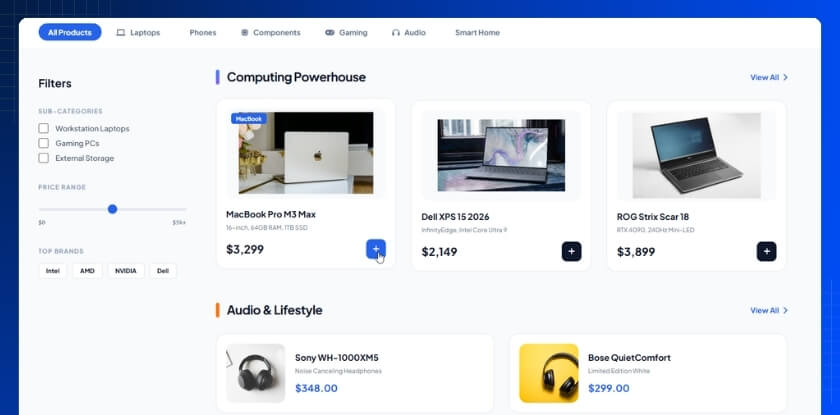
Dynamic AJAX Product Filters for WooCommerce is the stronger fit when filtering needs are tied to catalog complexity, not just storefront polish. Stores with more attributes, more product conditions, more structured data, or more advanced merchandising needs usually benefit more from its broader control model.
This kind of fit is common in:
- Electronics stores
- Auto parts and hardware catalogs
- Large apparel stores with layered attribute combinations
- Wholesale or B2B stores
- Agency-built WooCommerce stores
- Stores using custom fields, custom taxonomies, or advanced product grids
In these cases, the plugin is valuable because it gives the store more room to shape filtering around real catalog logic instead of staying limited to a simpler front-end experience.
Practical decision table
| Store Situation | Better Fit |
| You want filtering to feel cleaner with less setup effort | FiboFilters |
| Your catalog is visually driven and mobile browsing matters most | FiboFilters |
| Your team is non-technical and wants simpler management | FiboFilters |
| Your catalog uses custom product data beyond basic attributes | Dynamic AJAX Product Filters |
| You need filtering to adapt across different archive or builder contexts | Dynamic AJAX Product Filters |
| You expect filter logic and SEO requirements to grow over time | Dynamic AJAX Product Filters |
| You want stronger value without outgrowing the plugin quickly | Dynamic AJAX Product Filters |
Choose FiboFilters for simpler, experience-led filtering. Choose Dynamic AJAX Product Filters for WooCommerce if your store needs more control and long-term flexibility.
Final verdict
FiboFilters and Dynamic AJAX Product Filters for WooCommerce both improve product discovery, but they are built for different priorities.
FiboFilters is the better match for stores that want filtering to feel polished, mobile-friendly, and easy to manage. If the goal is to improve browsing with less setup friction and without spending much time shaping advanced filter behavior, it is a credible choice. That makes it especially suitable for storefronts where presentation and shopper comfort matter more than technical filter depth.
Dynamic AJAX Product Filters for WooCommerce is the stronger overall option for stores that need more than a clean front-end experience. Its broader filter coverage, fully reload-free AJAX flow, page-specific flexibility, stronger builder compatibility, and more advanced SEO URL handling make it a better long-term fit for growing catalogs and more demanding WooCommerce setups. It is also the better value choice for stores that want deeper capability without needing to replace their filter system as complexity increases.
So the fairest conclusion is this: FiboFilters is a strong usability-first option, but Dynamic AJAX Product Filters for WooCommerce is the better choice for stores that prioritize deeper control, stronger scalability, and a more flexible AJAX filtering system.